


Air Pollution: A Silent Killer – Causes, Health Effects of PM2.5 and Solutions for a Cleaner India
1. Introduction: Air pollution – a growing threat to India's future
Air pollution is one of the most serious environmental and public-health challenges facing India. It affects millions of people every day, irrespective of their age, occupation, economic status or geographical location.
The air we breathe is essential for life. However, the increasing concentration of harmful gases, microscopic dust particles, industrial emissions, vehicle exhaust, construction dust, agricultural residue burning and firecracker smoke is making the air unsafe in many Indian cities.
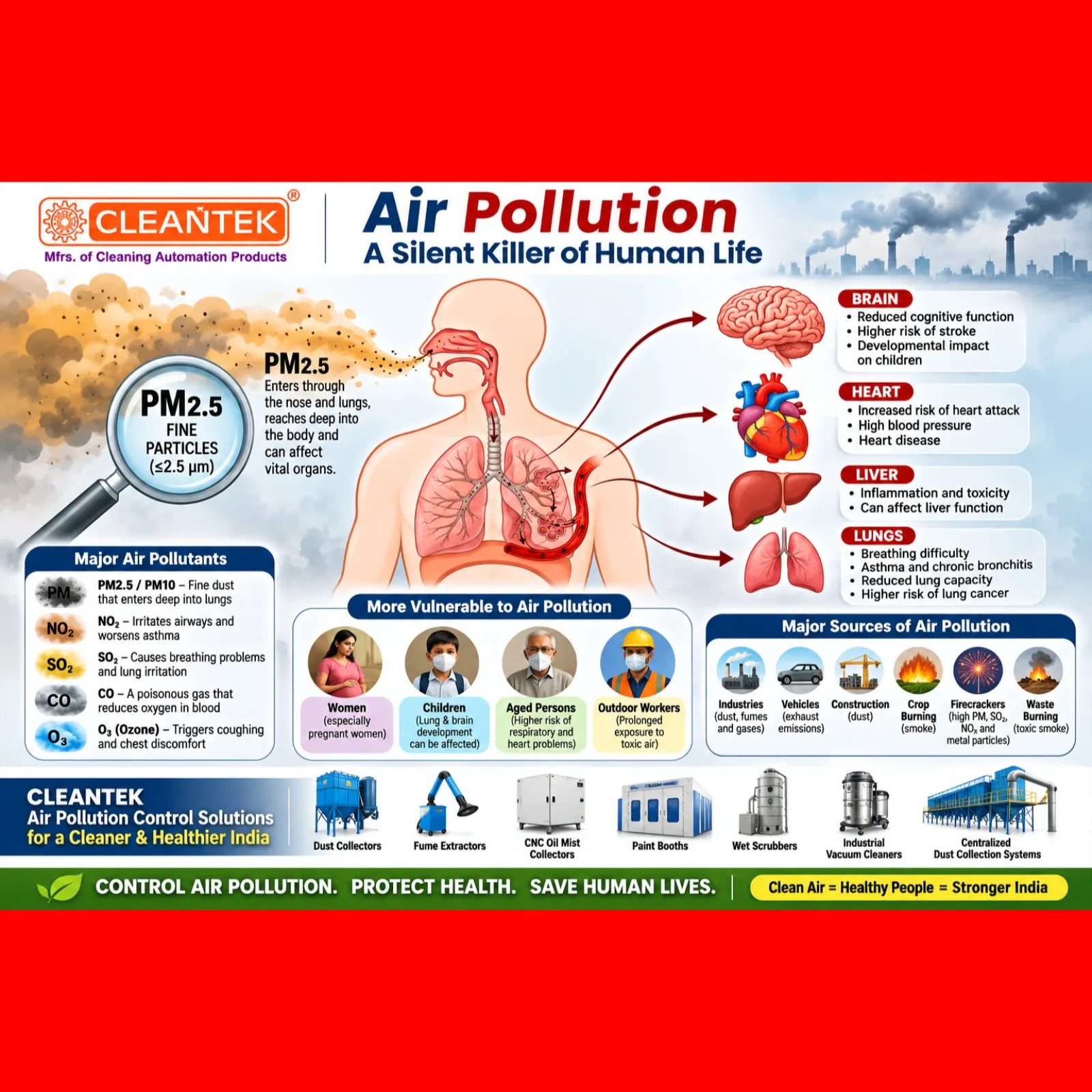
Air pollution is no longer just an environmental issue. It is also:
- A public-health emergency.
- A threat to children's physical and mental development.
- A risk to pregnant women and unborn babies.
- A major concern for elderly people.
- A cause of reduced worker productivity and lost working days.
- A threat to forests, agriculture, biodiversity and climate stability.
An economic burden on families, industries and the healthcare system.
One particularly concerning period in India is October to January. During these months, several regions experience worsening air quality due to changing weather conditions, lower atmospheric mixing, crop-residue burning, increased emissions and festive activities such as Diwali firecrackers.
The important point is that India's air pollution problem exists throughout the year. Diwali firecrackers add another concentrated source of pollution to an already polluted atmosphere.
2. History of air pollution and pollution control in India
Air pollution in India did not begin recently. It developed gradually with industrialisation, urbanisation, population growth, transportation and increased consumption of fossil fuels.
Period Major development:
- Before 1950 Smoke from coal, domestic cooking, traditional industries and urban activities was a major source of air pollution.
- 1950–1970 Industrialisation, coal-based power generation and urban population growth increased emissions.
- 1974 Central Pollution Control Board (CPCB) was established under the Water (Prevention and Control of Pollution) Act, 1974.
- 1981 Air (Prevention and Control of Pollution) Act was enacted to prevent and control air pollution.
- 1982 India's first National Ambient Air Quality Standards were adopted by CPCB.
- 1984 National Air Quality Monitoring Programme was initiated.
- 1994 National Ambient Air Quality Standards were notified.
- 2009 Revised National Ambient Air Quality Standards were notified, covering 12 pollutants.
- 2015 India's National Air Quality Index (AQI) was launched.
- 2019 National Clean Air Programme (NCAP) was launched to improve air quality in polluted cities.
- 2020 Bharat Stage VI vehicle emission standards were implemented nationwide.
- 2021 Commission for Air Quality Management (CAQM) was established for Delhi-NCR and adjoining areas.
- 2026 Further strengthening of monitoring networks and industrial emission controls is underway.
Important Indian environmental laws:
1. Air (Prevention and Control of Pollution) Act, 1981
This legislation provides the legal framework for preventing, controlling and reducing air pollution.
2. Environment (Protection) Act, 1986
This Act provides broad powers to the Central Government to protect and improve environmental quality.
3. National Ambient Air Quality Standards, 2009
These standards define permissible ambient concentrations for important air pollutants.
4. National Clean Air Programme, 2019
NCAP focuses on reducing particulate pollution through coordinated action by central, state and local authorities.
5. Commission for Air Quality Management Act, 2021
This provides a coordinated institutional framework for managing air pollution in Delhi-NCR and adjoining areas.
India faces several different sources of air pollution. Their relative contribution changes depending on the city, season, weather and industrial activity.
Major sources of air pollution
Source Major pollutants:
- Industrial emissions PM2.5, PM10, SO2, NOx, VOCs
- Vehicle emissions PM2.5, NOx, CO, hydrocarbons
- Coal-based power plants PM, SO2, NOx, mercury
- Construction activities PM10, PM2.5
- Road dust PM10, PM2.5
- Agricultural residue burning PM2.5, CO, organic compounds
- Waste burning PM2.5, PM10, toxic gases
- Domestic solid-fuel cooking PM2.5, CO, black carbon
- Firecrackers PM2.5, PM10, SO2, NOx and metal particles
